The skills that are useful everywhere, forever, for everyone.

Level 3 skills are the skills you possess to acquire or apply new skills, and to combine insights from different domains. There is great material to learn them, and this is my personal project to organise and structure all of it.

Or start with your career type
1Core craft 2Multipliers 3Meta-skills

Three levels of skill

One of the Level 3 skills, and this gets meta, is to be able to identify your Level 1, Level 2 and Level 3 skills, and to label them and name them.

Level 1: Core craft

The practical skills of a specific job: what you need to do the work itself, at a basic professional standard. Most people learn them at school, in an apprenticeship or in their first years on the job.

They travel only as far as the function. An industrial electrician can retool quickly for domestic wiring, but will struggle to step up as a factory foreman. And they wear out the fastest, as tools and methods change.

  • Wiring a building
  • Keeping the books
  • Diagnosing a patient
  • Writing code
  • Cutting hair
  • Teaching a class

Level 2: Multipliers

Skills that make you better at your job without being the job itself. You usually pick them up after you’ve become competent, often alongside people from other functions.

They build on experience and aren’t tied to the job you first trained for. They apply more widely than Level 1 skills and they last longer, but they stay tied to certain types of work in certain environments. They’re not as universal as Level 3 skills.

They come in two kinds.

Depth-extenders

They sharpen the craft you already have by borrowing techniques from other roles to improve your own.

  • Public speaking for someone promoted into management
  • Spreadsheet automation for a people manager
  • Statistics for a marketer

Bridging interfaces

You learn enough of somebody else’s job to be able to communicate effectively with them. You’re learning part of somebody else’s Level 1 skill to be able to work with them more effectively.

  • Managing people for a specialist who becomes a team lead
  • Job interviews for a new manager who has to hire
  • Basic Python for a project manager
  • Sales for a customer satisfaction manager

Level 3: Meta-skills

Skills about skills. The skills you use to learn new things, to apply what you know in new places, and to combine insights from different domains.

Level 3 skills are not directly relevant to the job you’re doing at all, which is why they apply everywhere: in any job, at any age. And they barely decay. The tactics to learn will change, but the half-life of the skill of learning is basically infinite. It’s like gold.

Still useful Years Level 3 Level 2 Level 1
Schematic, not data
How the three levels differ
1Core craft2Multipliers3Meta-skills
Where it appliesone functionacross functionseverywhere
How long it lastsdecays fastestdecays slowerbarely decays
Usually seen asa skillmostly a skilla trait

These aren’t traits.

As a society, we’ve come to treat Level 3 skills as traits. We look at them, throw up our hands and just say:

  • He is just the kind of guy who is really good at abstract reasoning.traitskill
  • She is just a great learner.traitskill
  • They have great metacognition.traitskill

These are all trait-like skills or skill-like traits, whatever you want to call them. But they can be developed, every single one of them, which is not to say it’s easy to develop them. It also doesn’t mean that if you read a book like Atomic Habits, all of a sudden you have better habits. Anything worthwhile takes work to learn.

I always say it’s like playing tennis. Everybody can be taught the basics of tennis or soccer or whatever you want. But that doesn’t mean that everybody can become a professional tennis player or a chess grandmaster. It is more like just knowing that this is a thing that you can develop.

Where do you learn this?

Level 3 skills are not being taught, and they are not being prioritised. We have time to teach our youth the history of 2,500 years ago. A high school student may understand more of the politics of the Romans than of their own future, the choices they have to make and the trade-offs that exist.

But enough people realise how important these skills are. So where do they turn? To the bookshop at the airport or the train station, to YouTube videos, to podcasts and LinkedIn posts. That has been my experience.

The 7 HabitsCovey
Atomic HabitsClear
Getting Things DoneAllen
Start with WhySinek
RangeEpstein
Thinking, Fast and SlowKahneman
The Black SwanTaleb
AntifragileTaleb
SuperforecastingTetlock
Thinking in BetsDuke
The Luck FactorWiseman
The Success EquationMauboussin
The Serendipity MindsetBusch
ChaosGleick

So what are the issues? I see three, and each one sets a goal for Level 3 Skills.

  1. Which skills matter to you

    Nobody is explaining the options that people have. Nobody is explaining the psychology that they have. So a big problem is that people simply don’t know which skills they should be working on.

    Goal one. Help you find the next thing to care about. Tools like the career type test show where you stand and where your gaps are, so you can pick your next topic and your next read.

  2. The scattered shelf

    These books are rather standalone. They can seem unconnected, competing with each other, or even contradictory. And while that may be true, there are general through lines. I do think there are universal storylines and threads that tie them together.

    Goal two. Identify the shared concepts and ideas at the heart of personal development.

  3. The missing how

    Some books are really practical and actionable, but quite a few are not. I love Start with Why, The Black Swan, Range, Chaos, Thinking, Fast and Slow and Antifragile. But these books are much more about showing an impressive outcome than about providing a guide to achieving it.

    Goal three. Identify the practical books and guides that actually show the path. Put another way: answer the question “so how do I do that?”, once a nonfiction book has convinced you that something is worth striving for. And where something hasn’t been turned into a method yet, build one.

The Level 3 Skills newsletter. Follow along as this gets built.

Level 3 concepts

  • A conceptual lexicon

    Our minds hold a rich library of ideas, a conceptual lexicon. Words and labels are the shortcuts our minds use to navigate these ideas. Take antifragile: it captures things that not only resist disorder but thrive in it. Knowing and using terms like that lets you communicate rich ideas with brevity and precision.

  • Holistic income

    Your career pays out in money, but also in learning, social capital, well-being and time. If you’re not earning money now, you’re probably earning free time or learning or social capital, with the idea that you’ll have money later. And that trade often comes true. The trade where you earn a lot of money now, and tell yourself you’ll get to friends, family or learning later, often doesn’t pan out. And when it doesn’t, people do stupid things to try to get it after all.

  • Learning how to learn

    The skill to learn allows you to quickly acquire new skills as old ones become obsolete. So the ability to learn quickly lets you keep up with the skills treadmill, and maybe even get ahead of it.

  • Metacognition and self-reflection

    They basically go hand in hand. Metacognition is the ability to know how you think: the thinking about your thinking. And this is immensely powerful, because metacognition can drive a lot of things, including emotion regulation.

  • Abstract reasoning

    It is the difference between seeing a red Volvo, a small four-person sedan, or even a mode of transport. By seeing it as a red Volvo, you’ve made it a very specific thing. If you think about sedans, you can put it into a category.

  • Combining insights from different domains

    You need to see how options trading and entrepreneurship and an ER doctor, and even a marriage with shared assets, are all very closely related risk management topics.

  • Knowing which skills matter to you

    Understanding what you care about in the long term, and how to get that in a way that protects your interests and your values along the way. The first step is just knowing what your options are.

    Your Career Type
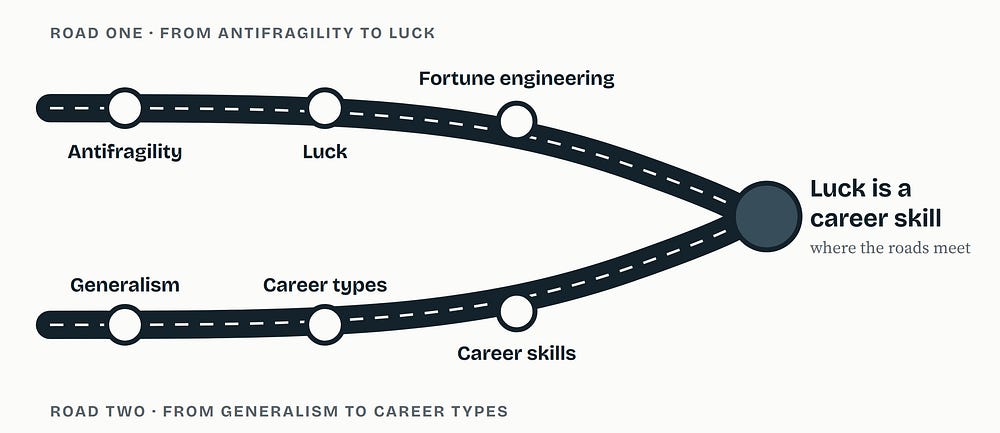
  • Engineering your luck

    Luck touches nearly every outcome that matters. Can luck be learned, or at least managed?

    Fortune Engineering
Rik Visser

A note from Rik Visser

I’m definitely no guide who never got lost.

On a Tuesday in December 2013, before the markets opened, I received a glowing performance review at Amsterdam’s most prominent derivatives trading firm. Eight hours later, at the peak of my career thus far, I turned in my letter of resignation to my bewildered manager. This wasn’t the first, or last, time I had left a job at which I was successful.

I produced a feature film that sold to eleven countries, built a software company and founded a co-working space. If you look at my resume, it feels random. But the through line is that I bring together people, money and ideas around a single idea, and we make that.

I’ve always known intuitively when to move on. But perhaps if I could put words or even a theory to the intuition, I could both better explain myself and help other people.

Since 2021, I’ve had the privilege of giving guest lectures at the University of Amsterdam on entrepreneurship, and on what they won’t teach you in school. Never in those hundreds of students has anybody actually thought about these things. So I want to join the conversation. This is a land I have traveled, and I am by no means the best at it. But I have seen quite a bit of it, and I think I can be one of the guides.

I find the best way to wrap up thinking is to actually produce something. And if I produce it, I might as well share it.

Rik Visser

Amsterdam

The work so far

I have a day job, so I can’t release it all in one go.

Your Career Type

yourcareertype.com · step one

The first step is just knowing what your options are. Those are the sixteen career types I’ve identified, based on the career dimensions.

Go to Your Career Type

Fortune Engineering

fortuneengineering.org · in progress

Can luck be learned, or at least managed? A long-form, interview-driven investigation, with philosophers alongside complexity scientists alongside business strategists.

Go to Fortune Engineering

The Level 3 Skills newsletter

In the newsletter, there will be announcements when I add features to the site. And there will be essays on exactly this.

Free. Opens Substack to confirm.